
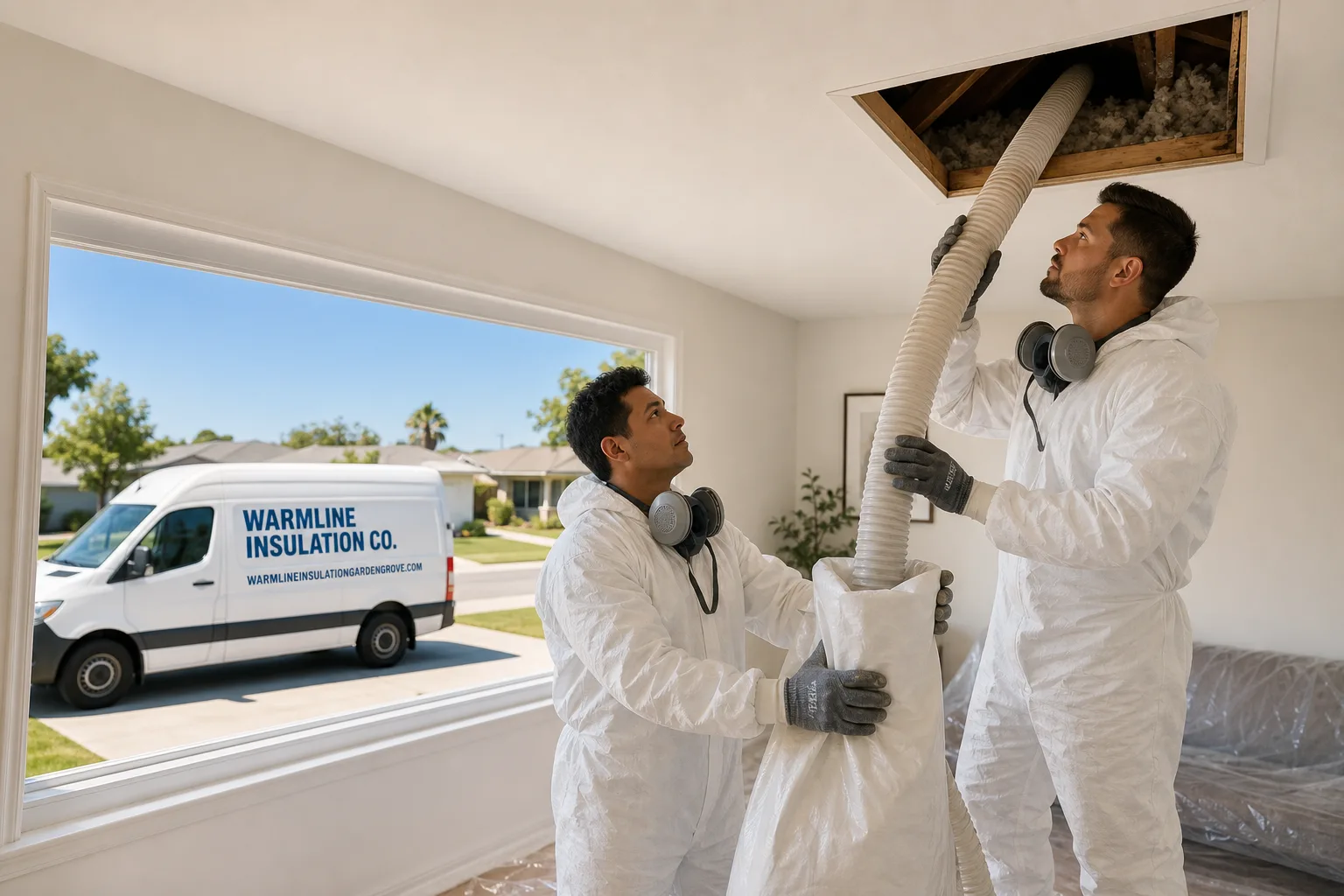
How Much Does Wall Insulation Cost in Garden Grove?
Wall insulation in Garden Grove, CA typically costs between $1.50 and $4.25 per square foot, depending on the method, material, and whether your walls are open (new construction or mid-renovation) or closed (existing drywall in place). Most Garden Grove homeowners spend between $1,800 and $6,500 for a full interior wall insulation project on a standard single-family home. Spray foam and injection foam for closed walls sit at the higher end; blown-in fiberglass or cellulose through drilled holes lands in the middle; and open-wall batts - most common during renovations or room additions - are the most budget-friendly option.
Wall Insulation Cost Breakdown (2026)
Garden Grove sits in IECC Climate Zone 3B, which means state Title 24 energy code requires a minimum R-13 in exterior walls for most residential projects. That baseline shapes what materials make sense here and, by extension, what you’ll actually pay. Below are real market ranges for the Garden Grove area as of 2026 - not national averages pulled from a generic database.
| Method | Best For | Cost Per Sq Ft | Typical Project Total |
|---|---|---|---|
| Fiberglass Batt (open wall) | Renovations, room additions, new construction | $0.90 - $1.60 | $900 - $2,800 |
| Mineral Wool / Rockwool Batt (open wall) | Fire resistance, sound control, open walls | $1.40 - $2.20 | $1,400 - $4,000 |
| Blown-In Fiberglass (closed wall) | Existing homes, no drywall removal needed | $1.80 - $2.80 | $1,800 - $5,200 |
| Blown-In Cellulose (closed wall) | Older homes, eco-conscious buyers | $1.70 - $2.60 | $1,700 - $4,800 |
| Injection Foam (closed wall) | Maximum air sealing, no drywall disruption | $2.80 - $4.25 | $2,800 - $7,500 |
| Open-Cell Spray Foam (open wall) | New construction, gut renovations | $1.80 - $2.50 | $1,800 - $4,500 |
| Closed-Cell Spray Foam (open wall) | Moisture-prone areas, garages, bonus rooms | $3.00 - $5.50 | $3,000 - $9,500+ |
| Old Insulation Removal + Replacement | Older homes with degraded or pest-damaged fill | $2.50 - $5.00 (combined) | $2,500 - $8,500 |
What drives these numbers up or down? A 1,400-square-foot ranch-style home in West Garden Grove with block walls behaves very differently than a two-story craftsman near the Chapman Avenue corridor with 2×4 wood-frame exterior walls. Block and stucco construction – common in the older tracts built between the 1950s and 1970s throughout Garden Grove – often requires interior furring strips or rigid foam board before any batt insulation can be installed, which adds $0.50 to $1.25 per square foot to the base price. Homes with knob-and-tube wiring also require an electrical inspection before blown-in insulation can go near those walls; plan for a separate trade call if your Garden Grove home predates 1960.
Labor in Orange County runs higher than the national average. Crew wages, fuel, and disposal fees all factor into your final number. That said, upfront pricing means you know the total before a single hole is drilled – there are no surprise line items on the invoice.
What Affects Wall Insulation Pricing in Garden Grove
- Open vs. closed walls: If your drywall is already up, the only way in is through drilled holes (blown-in or injection foam) or removing the drywall entirely. Drilling and patching adds labor; drywall removal adds both labor and a drywall re-hang cost on top of the insulation work. In Garden Grove’s older housing stock – particularly neighborhoods like West Grove and Brookhurst – most jobs are closed-wall, which nudges prices toward the middle and upper end of our table.
- Wall construction type: Wood-frame 2×4 walls are the most straightforward to insulate. But a significant portion of Garden Grove homes built before 1975 have CMU (concrete masonry unit) or poured-concrete walls – especially on the ground floor. These require a different approach entirely, typically interior rigid foam board or spray foam, and the added material cost is real.
- Linear footage and number of exterior walls: Pricing is typically quoted per square foot of wall cavity, not per room. A corner unit or a home on a large lot with significant exterior wall exposure will cost more than a narrower row home. Garden Grove’s grid-style neighborhoods often have homes with three full exterior walls plus a shared or setback wall, so actual wall square footage varies more than lot size suggests.
- Access and obstacles: Electrical outlets, plumbing runs, blocking between studs, and fire stops all slow the drilling-and-filling process. Older Garden Grove homes frequently have mid-wall blocking installed during original construction – a code requirement of the era – which requires additional holes and passes to fully fill each stud bay.
- Material choice and R-value targets: Title 24 sets the floor at R-13 for most exterior walls, but many Garden Grove homeowners in the Buena Clinton and Morningside neighborhoods specifically request R-19 or R-21 performance – achieved with higher-density batts or two-pass blown-in jobs – after experiencing how warm south-facing rooms get in July and August. Upgrading from minimum code to R-21 typically adds $0.30 to $0.70 per square foot.
- Simultaneous scope discounts: Garden Grove homeowners who pair wall insulation with attic insulation or Wall Insulation in Garden Grove air sealing work in the same visit often see a meaningful reduction in per-project labor overhead. Mobilizing one crew for two scopes beats scheduling two separate jobs.
Wall Insulation by Material: What We Use and Why
Fiberglass Batts – Owens Corning and Johns Manville
For open-wall projects during a kitchen remodel or room addition, fiberglass batts from Owens Corning or Johns Manville are the go-to. They’re cost-effective, available in R-13, R-15, R-19, and R-21 widths, and install quickly in standard 2×4 and 2×6 bays. The limitation in Garden Grove’s market: once the drywall goes up, batts are no longer an option without tearing it back down.
Rockwool (Mineral Wool) Batts
Rockwool batts cost roughly 40-60% more than fiberglass but deliver meaningfully better sound attenuation – a real selling point for Garden Grove homes near the 22 Freeway corridor or along Brookhurst Street. Rockwool also handles the rare but real moisture scenario better than standard fiberglass, and its fire-resistance rating is significantly higher. For interior walls between a garage and living space, Rockwool is often the right call regardless of the extra cost.
Blown-In Fiberglass and Cellulose – GreenFiber and Knauf
Blown-in insulation is the method most Garden Grove homeowners with finished walls end up choosing. A small hole is drilled in each stud bay (typically from the exterior through the stucco, or from the interior through the drywall), a dense-pack hose is inserted, and the cavity is filled under pressure. GreenFiber cellulose and Knauf blown-in fiberglass are the materials we rely on here – both are well-tested for dense-pack applications and hold their R-value over time without significant settling.
Injection Foam
Injection foam is the premium closed-wall option. Unlike blown-in, it expands to fill gaps and voids that a blown-in hose might miss – particularly useful in older Garden Grove homes where mid-wall blocking or settling has created irregular cavity shapes. It also creates a superior air seal, which matters in a climate where warm air infiltration during October’s Santa Ana wind events can spike indoor temps by 10 degrees in an afternoon.
Spray Foam – Icynene and Demilec
Open-cell and closed-cell spray foam from Icynene and Demilec are used primarily in open-wall scenarios: gut renovations, new construction, or garage conversions. Closed-cell at 2 inches delivers R-13 with a vapor retarder built in, which is why it sees use in Garden Grove’s occasional moisture-adjacent situations – homes near the Santa Ana River flood plain or properties with history of wall condensation. Open-cell is more economical and fills the stud bay completely, though it needs a vapor check in specific applications.
Garden Grove-Specific Factors You Won’t Read About on a Generic Insulation Site
Garden Grove’s housing stock is concentrated in a fairly narrow age range: the city grew rapidly between 1950 and 1975, and a large share of its single-family homes date to that era. That matters for wall insulation in ways that affect both method choice and price.
Homes built before 1965 in Garden Grove frequently have no insulation in the exterior walls at all – not degraded insulation, but a completely empty cavity. When we drill into the exterior wall of a home in the Lampson corridor or near Euclid Street built in 1958 and pull the drill bit out, we often find nothing but air and decades of settled dust. These homes respond dramatically to added wall insulation: homeowners in Garden Grove’s older neighborhoods routinely report a 12-18% drop in cooling costs after a closed-wall blown-in project, which at Southern California Edison’s current residential rates for this zip code can mean $200-$350 in annual savings for a 1,600-square-foot home.
The soil and foundation type in Garden Grove also plays a role. Homes with raised foundations and crawl spaces sometimes have interior wall cavities that are partially open to the subfloor space, meaning blown-in material can settle downward or drift if the cavity isn’t properly dense-packed. This is a known issue in the older tracts near Trask Avenue, and it’s one reason density matters as much as material selection when specifying a blown-in job.
Garden Grove also sits in a liquefaction-risk zone in certain areas near the Santa Ana River. Homes there sometimes underwent seismic retrofitting that added interior shear panels – plywood nailed directly to the studs before drywall. These panels block access for dense-pack drilling in those specific bays, and the installer needs to plan around them or drill from the exterior. It’s not a deal-breaker, but it’s the kind of detail that a contractor who hasn’t worked extensively in Garden Grove might miss until they’re already on-site.
How to Save on Wall Insulation in Garden Grove
There are a few concrete ways to reduce what you spend – without cutting corners on performance.
Time your project with a renovation
If you’re planning a bathroom remodel, electrical panel upgrade, or kitchen gut, those trades will open drywall anyway. Scheduling wall insulation during that window converts a closed-wall job (which requires drilling and patching) into an open-wall batt job, often cutting the material and labor cost by 30-40%. Even if the renovation is only touching one room, it’s worth asking which adjacent exterior walls might be accessible at the same time.
Bundle with attic work
Mobilizing a crew for a single-visit attic-and-wall project costs less per scope than two separate trips. Most Warmline jobs – including combined attic sealing and wall insulation projects – are completed in a single visit. If your attic insulation is also undersized (very common in Garden Grove homes that haven’t been touched since the 1970s), doing both at once is the most cost-efficient path.
Ask about the $50 Off Any Repair Over $250 offer
Warmline’s standing offer of $50 off any repair over $250 applies to qualifying insulation work. If you’re adding or upgrading wall insulation as part of a repair scope, ask about it when you call. The 5% Senior and Veteran discount is also a permanent offer – if you’ve served or qualify by age, mention it and it comes off your total, no paperwork games.
Get a home energy audit first
A home energy audit identifies exactly where your home is losing conditioned air. It’s a diagnostic tool, not a sales pitch. In some Garden Grove homes, the audit reveals that the walls are actually performing adequately but the attic is completely uninsulated – meaning wall insulation, while eventually worthwhile, isn’t the highest-ROI first move. Spending $89 on a seasonal tune-up or a proper energy audit before committing to a $4,000 wall project can help you sequence your insulation investments in the right order.
Call for a free estimate before deciding on method
Different methods carry very different price tags. A contractor who defaults to injection foam for every closed-wall job may not be serving your actual budget or building type. Call (657) 213-3642 and a live person will answer – not a voicemail, not a call center. Warmline provides upfront pricing so you know exactly what you’re agreeing to before any work starts. Free estimates cost you nothing; an uninformed decision about method can cost you thousands.
Is Wall Insulation Worth It in Garden Grove’s Climate?
Garden Grove’s climate is mild by most standards – average highs in the low 80s in summer, lows rarely below 45 in winter. That mild reputation leads some homeowners to deprioritize wall insulation, reasoning that the temperature differential between inside and outside isn’t that severe.
That reasoning holds up in the middle of March. It falls apart in August and during Santa Ana wind events, when exterior wall temperatures on south- and west-facing surfaces can climb above 120°F on the surface and push 90°F+ into the wall cavity. An uninsulated exterior wall in those conditions becomes a radiant heat panel on the interior side – and no amount of air conditioning efficiently compensates. Garden Grove homeowners in neighborhoods like Garden Park and West Garden Grove with west-facing living rooms know this problem intimately.
The ROI calculation in Garden Grove is favorable for most homes built before 1985. Assuming a mid-range blown-in project at roughly $3,200 and an annual energy savings of $250-$350, the simple payback period runs 9-13 years. Given that quality blown-in insulation lasts 40-plus years without replacement, that’s a straightforward investment – particularly when you factor in the improved comfort during the 2-3 months per year when Garden Grove heat actually becomes a daily problem.
For a fuller picture of everything we do under one roof, visit our home page.
FAQs – Wall Insulation Cost in Garden Grove
How much does wall insulation cost per square foot in Garden Grove, CA?
Wall insulation in Garden Grove costs between $1.50 and $4.25 per square foot for most standard residential projects in 2026. Blown-in fiberglass or cellulose for closed walls runs $1.70-$2.80 per square foot; injection foam for closed walls runs $2.80-$4.25; open-wall batt installation starts around $0.90-$1.60 per square foot. Total project costs typically land between $1,800 and $6,500 for a standard single-family home. Call (657) 213-3642 for a free estimate specific to your home’s wall type and square footage.
Do I have to remove drywall to insulate my walls in Garden Grove?
No – in most cases, drywall removal is not required. Blown-in insulation (fiberglass or cellulose) and injection foam are specifically designed for closed-wall applications: small holes are drilled through the exterior stucco or interior drywall, the cavity is filled under pressure, and the holes are patched and painted. This approach is standard for the older finished homes that make up the majority of Garden Grove’s housing stock. Drywall removal is only necessary if you’re doing a full gut renovation or if existing insulation is so degraded or pest-contaminated that complete replacement is required. Call (657) 213-3642 to find out which method fits your situation.
How long does wall insulation installation take for a typical Garden Grove home?
Most wall insulation projects on a standard Garden Grove single-family home are completed in a single day, often in 4-8 hours depending on the method and scope. Blown-in and injection foam jobs for a 1,400-1,800 square foot home with standard exterior walls typically take one crew one full day, including drilling, filling, patching, and cleanup. Open-wall batt jobs move faster. If your project includes simultaneous attic work, plan for a full day but still typically one visit. Call (657) 213-3642 and we’ll give you a realistic time estimate once we know your home’s specifics.
What type of wall insulation works best for older Garden Grove homes built in the 1950s-1970s?
Dense-pack blown-in cellulose or blown-in fiberglass is the most practical choice for most older Garden Grove homes with finished walls and no existing insulation. These materials fill irregular cavity shapes well, handle the mid-wall blocking common in homes of that era, and require only small drilled holes rather than drywall removal. Injection foam is the higher-cost alternative that provides better air sealing – worth considering on homes near the 22 Freeway where outdoor air quality and noise are secondary concerns. For any home with suspected pest activity or deteriorating existing insulation, we recommend starting with an assessment before choosing a method, since contaminated cavities need cleaning before new insulation goes in. Call (657) 213-3642 to discuss your specific home.
Are there rebates or incentives for wall insulation in Garden Grove?
Yes – Southern California Edison and SoCalGas both offer rebates for qualifying insulation upgrades in the Garden Grove service area, and federal tax credits under current energy efficiency provisions may apply to wall insulation work that meets minimum R-value thresholds. The specific rebate amounts and program availability change annually, so the most reliable step is to check directly with your utility provider and consult IRS guidance on the Energy Efficient Home Improvement Credit before your project. A home energy audit can also document the pre- and post-improvement condition of your home, which is often required for rebate applications. Call (657) 213-3642 and we’ll walk you through what documentation we can provide to support a rebate claim.
Is it cheaper to insulate walls or the attic first?
In most Garden Grove homes, attic insulation delivers a faster payback than wall insulation and should typically come first. Heat gain through an uninsulated or underinsulated attic is generally greater than through walls in Southern California’s climate, and attic work is often less expensive per square foot. That said, homes with zero wall insulation – common in Garden Grove’s pre-1965 tracts – benefit significantly from adding wall insulation even if the attic is already addressed. The best way to prioritize is a home energy audit that quantifies where your specific home is losing the most conditioned air. Call (657) 213-3642 for a free estimate and we can help you sequence the work in the order that gets you the most return.
Why Garden Grove Homeowners Choose Warmline
Warmline Insulation Co. has been working in Orange County homes since 2011 – long enough to know the difference between a Garden Grove ranch-style built in 1962 and a 1990s two-story in the eastern part of the city, and to spec each one correctly rather than applying a one-size approach. Neil Ashford built this company around a straightforward idea: give homeowners real information, real pricing, and work that holds up. The 90-Day Done Right Promise is the written expression of that – if the work isn’t right, we make it right. No conditions, no runaround.
Every technician we send to your Garden Grove home is background-checked and uniformed. Every quote is upfront – you’ll know the total before anyone picks up a drill. And when you call (657) 213-3642, a live person answers. Not a voicemail. Not an answering service. A person, any hour.
We carry materials from Owens Corning, Rockwool, CertainTeed, Icynene, Demilec, Johns Manville, Knauf, and GreenFiber – the brands that have been the standard in residential insulation for decades. We don’t substitute cheaper material without telling you, and we don’t upsell a method that isn’t right for your walls. The goal is a home that’s measurably more comfortable, with energy bills that reflect the work we did.
If you’re a senior or veteran, our 5% discount applies permanently to your total – just mention it when you call. And if your project qualifies, the $50 off any repair over $250 offer is yours to use.
Get Your Free Wall Insulation Estimate in Garden Grove
Stop guessing at why certain rooms in your Garden Grove home run hot in August or drafty in January. Wall insulation is often the missing piece – and finding out what it will cost you takes one phone call. Call (657) 213-3642 today for a free, upfront estimate. A live person will answer, we’ll ask the right questions about your home, and we’ll give you a real number. Most jobs are completed in a single visit, and all work is backed by the 90-Day Done Right Promise.
Pricing reflects the Garden Grove market as of 2026. Warmline Insulation Co. offers free estimates – call (657) 213-3642.
Written by Neil Ashford, Owner at Warmline Insulation Co., serving Garden Grove since 2011.
What Our Customers Say
"Injection foam in the walls of our 1950s house - no drywall demolition, just small holes patched and painted the same day. The street noise in the front bedroom is half what it was."
- Yasmin Farah"Crawl space smelled musty and the floors were cold. Full encapsulation with the thick liner taped at every seam, and a dehumidifier sized for the space. The hygrometer they left reads 48 percent now instead of the 70s."
- Elena Vasquez"They did the energy audit first - blower door and thermal camera - and showed me exactly where the house was leaking before selling me anything. The fix ended up being air sealing plus a modest attic top-up, not the full replacement another company pushed."
- Grace Nakamura